
Chanel – The Glorious Era of the 1980s and 90s Led by Karl Lagerfeld
Fashion icon Karl Lagerfeld once said, "Fashion is fleeting." However, the classics he created for Chanel, like his own iconic image, are etched in the fashion world. Since joining Chanel in the 1980s, he led the then-struggling brand back to life, rewriting fashion history. Let's take a look back at the miracles he created in his early years.

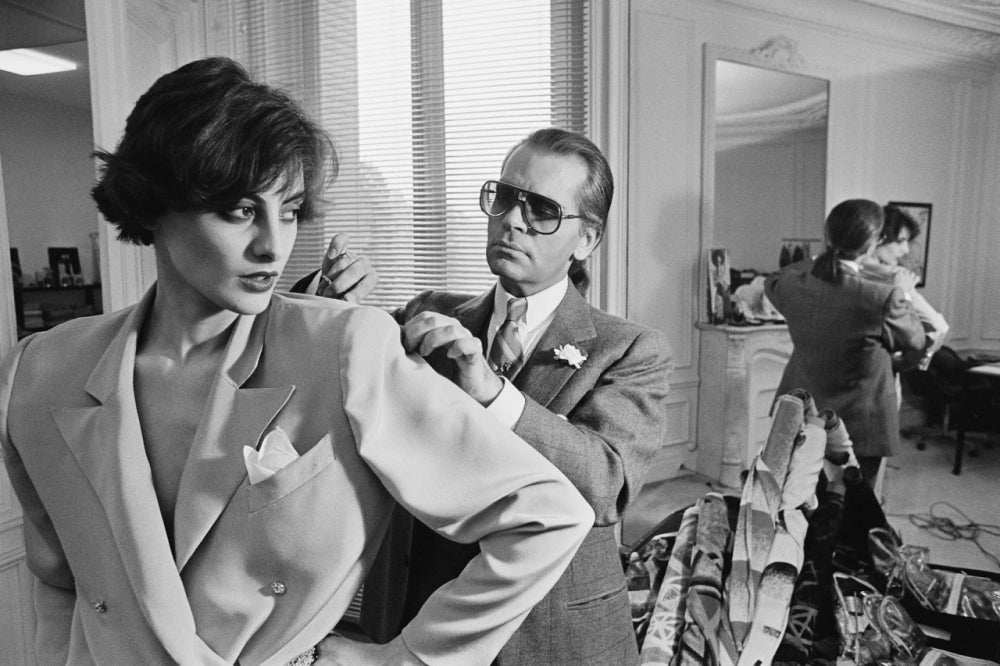
Karl Lagerfeld, photographed by Helmut Newton in 1983. (Chanel official website)
Became Chanel's Creative Director in 1983
Karl Lagerfeld was born in a small town north of Hamburg, Germany in the 1930s. Influenced by his fashion-loving mother, he was very particular about his clothing from a young age. Before he was even 20, he had already made a name for himself in the fashion world. In 1954, he participated in the first International Woolmark Prize design competition, winning first place in the amateur category, while another designer who won that year was Yves Saint Laurent. After the competition, Karl was invited to work as a stylist at Balmain, and later became a designer at Jean Patou. At that time, haute couture was still the mainstream, which gradually made him feel bored, until the 1960s, when the fashion industry ushered in a new era of ready-to-wear that met the needs of the masses, igniting Karl's unprecedented fighting spirit and creativity. Later, he joined Chloé and Fendi, and his collaboration with the latter lasted for half a century.

Karl Lagerfeld passed away on February 19, 2019, at the age of 85. (ELLE HK)
He once described Fendi as representing his identity in Italy, while Chanel represented his self in France. In 1983, Karl Lagerfeld became the creative director of Chanel, and for most of his life thereafter was inextricably linked to the brand's fate. He mentioned in interviews more than once his initial feelings upon joining the brand: "When I joined Chanel, she was still a sleeping beauty, and not a very beautiful one, because she was still snoring."

Karl consistently strived to continue Gabrielle Chanel's spirit of freedom. (Vogue France)
Incorporating his own creativity into the independent, confident, and modern spirit that Gabrielle Chanel shaped for women, Karl reinterpreted a series of classic pieces. He emphasized Chanel's signature elements, such as the double C logo and the camellia, while ensuring that the Flap Bag, Tweed jacket, little black dress, and pearl jewelry evolved with the times, remaining timeless and relevant. He once stated, "My job is not to repeat what she (Gabrielle Chanel) did, but to carry on her legacy and make the classics shine. Chanel's strength lies in the fact that its philosophy can be applied to many things."

Karl Lagerfeld with his close collaborator, photographed at the 1985-1986 Autumn/Winter fashion show. (Vogue France)
Elegant and chic classic designs
When Karl Lagerfeld first took over Chanel, the brand had been declining for 12 years since the founder's death, lagging far behind other contemporary French brands and unable to resonate with the tastes of the new generation of consumers. It had almost become synonymous with outdated and antiquated. Therefore, his biggest task was to inject a modern style into the designs and restore the brand's luster.

1983 Haute Couture collection. (ELLE HK)
First Collection
Karl Lagerfeld's first achievement after taking the helm was the Haute Couture collection. He reinterpreted traditional French craftsmanship, infusing daywear, evening wear, and even wedding dresses with youthful elements while maintaining their elegance and sophistication. The subsequent ready-to-wear collection, including tweed jackets, little black dresses, and two-tone shoes, gave these items, considered long past their grandmothers' wardrobes, a complete makeover. It preserved the classic essence while injecting an elegant and chic modern twist, combining comfort and style. As a result, despite initial skepticism from both outsiders and internal staff, Chanel regained its former glory.

1983-1984 Autumn/Winter Fashion Show (Vogue France)
In 1978, a WWD article described Karl's work as "clever yet elegant." While his designs were often lavish, Karl successfully combined innovative vision with commercial success. He possessed a keener business acumen than many designers, focusing not only on beautiful styles but also on what people wanted most at the time—a principle aligned with Gabrielle Chanel's creative philosophy.

1987-1988 Haute Couture Autumn/Winter Fashion Show (Vogue France)
Suit & Jacket
A classic coat often has a lifespan exceeding ten years. The tweed coat, born in the 1950s, is one of Chanel's signature pieces. Gabrielle Chanel believed that the overly restrictive women's clothing of the time was inappropriate, so she designed coats using Scottish tweed as the main material, combining a style that was both strong and soft. Karl Lagerfeld once wrote in his book, "Some designs in the fashion world are timeless, such as jeans, white shirts, and of course, a Chanel jacket."

Penélope Cruz wore the first Chanel garment designed by Karl Lagerfeld in 1983, gracing the cover of the April 2019 issue of Vogue Spain, paying tribute to the fashion legend who passed away that year. (Vogue Spain)

In 1997, Princess Diana wore a light blue Chanel suit with a matching bowler hat to Prince William's confirmation ceremony at Windsor Castle. (Vogue Taiwan)

Supermodel Claudia Schiffer, a former Chanel ambassador, frequently wore the brand's clothing. (Vogue HK)
Under Karl Lagerfeld's unique vision and design approach, Chanel's classic suits retained their elegance and femininity while incorporating structured tailoring and fashionable details. Tweed was no longer just a traditional fabric, but transcended past constraints, changing with each season in different colors, collars, piping, and jeweled buttons, making the classic styles more diverse and enriching, becoming timeless classics and even cultural symbols.

1983-1984 Autumn/Winter Fashion Show (Vogue France)

Spring/Summer 1984 Fashion Show (Vogue France)

Spring/Summer 1986 Fashion Show (Vogue France)

Spring/Summer 1993 Ready-to-Wear Fashion Show (Vogue France)
Little Black Dress
The little black dress is now a wardrobe essential for women, but it was once considered a somber and unlucky widow's outfit. Gabrielle Chanel published her design sketches for the little black dress in 1926. Its simple and elegant design—a straight neckline, a straight cut, and a length reaching mid-calf—suited to various occasions and styles, thus becoming one of Chanel's iconic designs.

Spring/Summer 1985 Fashion Show (Vogue France)

Spring/Summer 1987 Fashion Show (Vogue France)

Autumn/Winter 1987-1988 Haute Couture Show (Vogue France)
During his 36-year tenure at Chanel, Karl Lagerfeld repeatedly reinterpreted the little black dress. His design philosophy was to allow women to freely express themselves, showcasing confidence and individuality based on the little black dress. "One success is nothing; you have to surpass it time and time again, and ideally, be different." By using different materials, cuts, and accessories, he continuously infused this classic design with creativity and fashion, creating different looks and styles by pairing it with various accessories such as pearl necklaces, statement earrings, and metal chains.

Spring/Summer 1990 Haute Couture Fashion Show (Vogue HK)

Autumn/Winter 1991-92 Haute Couture Fashion Show (Vogue HK)
11.12 Classic Bag
The Chanel 2.55 handbag was designed by Coco Chanel in February 1955, inspired by the quilted jackets worn by grooms. The quilted stitching gives the bag a more defined silhouette and a more robust structure. It features a flat metal chain shoulder strap and the original rectangular turn-lock "fermoir 'Mademoiselle'" (Women's Lock), which remains timeless even years later.

Chanel 2.55 Handbag (Chanel Official Website)

Chanel 11.12 Handbag (Chanel Official Website)
As Karl Lagerfeld said, "I admire Coco Chanel, but she is not me." In 1983, he launched a new handbag based on the 2.55 bag, naming it the Chanel 11.12 handbag (also known as the Classic Bag). Its two main features are: replacing the original metal chain of the 2.55 with a shoulder strap interwoven with metal and leather, and replacing the rectangular clasp with the double C logo, reflecting the trademark craze of that era. The 11.12 handbag is meticulously crafted, handmade in the Chanel ateliers, involving over 180 steps. Even today, it is updated every season with different materials and colors, and its value continues to appreciate, proving its enduring appeal.


The interior design of the 11.12 handbag retains the original 2.55 design. (ELLE Taiwan)

In 1996, Princess Diana paired a light green suit with a Chanel quilted flap bag and two-tone heels. (Vogue Taiwan)

Spring/Summer 1992-93 Fashion Show (W Magazine)
Jewelry & Accessory
Combining modern and classic elements, Karl Lagerfeld brought many glamorous vintage jewelry pieces to Chanel, adding a touch of luxury to the clothing and showcasing his pursuit of perfect coordination. The double C logo, the number "5," pearls, camellias, and metal chains were frequently used in various looks, becoming important symbols of the brand's recognizability.

Spring/Summer 1986 Fashion Show (Vogue France)

Autumn/Winter 1987-1988 Fashion Show (Vogue France)

Spring/Summer 1988 Fashion Show (Sina)

Spring/Summer 1992-93 Fashion Show (W Magazine)

Chanel Spring/Summer 1993 Ready-to-Wear Fashion Show (Vogue HK)

Spring/Summer 1991-1992 Fashion Show (W Magazine)
The Muse of Inspiration in Karl Lagerfeld's Eyes
The visionary Karl Lagerfeld pioneered the star effect as early as the early 1980s, alongside Parisian fashion supermodel Inès de la... The collaboration with Fressange became a significant milestone for Chanel. Besides modeling in Chanel's early fashion shows, Inès was invited to join the creative core of the studio and became the brand's first official ambassador. This collaboration not only brought Chanel more attention but also injected youthful energy into the brand.

Inès de la Fressange became the protagonist of the 1984 Coco perfume advertising campaign. (Chanel official website)

The androgynous Stella Tennant was one of Karl Lagerfeld's muse. (Vogue France)
Over the years, many Hollywood actors, musicians, models, and friends have played the role of muses in Karl Lagerfeld's design career, helping him evoke moments of beauty and emotion, and showcasing different facets of the Chanel woman with their distinct charms.

Catherine Deneuve is a style icon of her generation. (Vogue France)

Claudia Schiffer, Karl Lagerfeld, Christy Turlington, and Linda Evangelista, photographed at the 1992-1993 Haute Couture Fall/Winter Fashion Show. (Vogue France)
Furthermore, as a designer with a passion for photography, Karl Lagerfeld frequently took the lead in shooting advertising campaigns for Chanel since the 1980s, showcasing his photographic talent and artistic vision. He collaborated with numerous renowned models and artists, creating unforgettable photographs that not only showcased Chanel's clothing and accessories but also conveyed Karl's unique understanding of beauty and emotion.

The first advertising campaign Karl Lagerfeld created for Chanel between 1987 and 1988, featuring Inès de la Fressange. (Chanel official website)

The 1995 Spring/Summer fashion campaign shot by Karl Lagerfeld, featuring Helena Christensen and Claudia Schiffer. (Chanel official website)

Karl Lagerfeld invited Stella Tennant to model the 1996/1997 Autumn/Winter fashion collection. (Chanel official website)

At the 2022 Spring/Summer fashion show, Chanel's current creative director, Virginie Viard, led the audience back to the 1980s at the Grand Palais in Paris, incorporating photographic elements as a tribute to Karl. (Vogue HK)
Gabrielle Chanel's personality and vision laid an important foundation for Chanel, while Karl Lagerfeld, while respecting the brand's DNA, constantly explored new design elements and ways of expression, giving the brand a second life through a series of creative garments and injecting endless motivation, allowing Chanel to continue to lead the fashion world.