
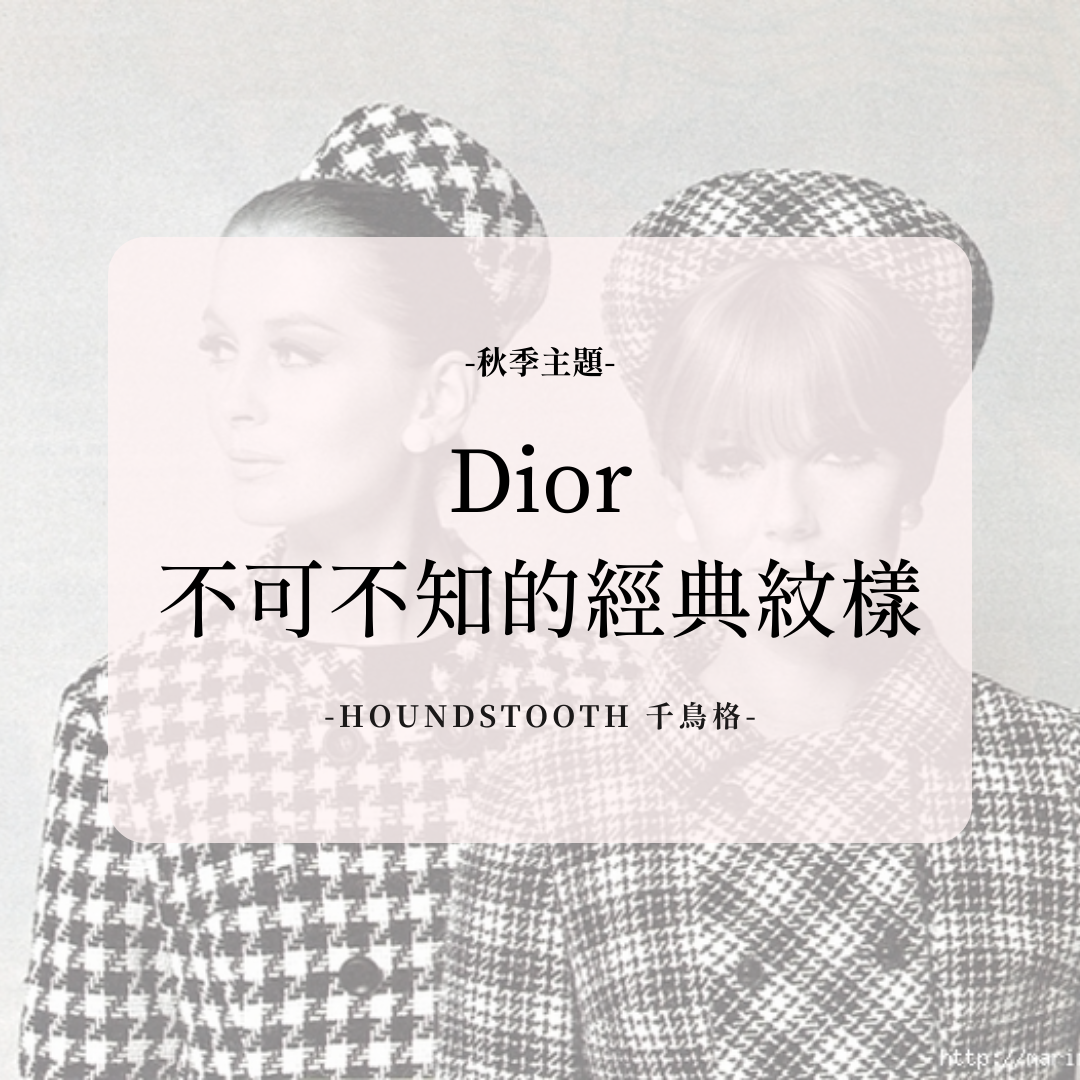
Dior – A Classic Pattern You Can't Miss
Houndstooth
Houndstooth is a symbol of elegance and sophistication, and it's beloved by British and European royalty. It transcends time, appearing on the clothes of nobles over a century ago and in the wardrobes of modern urban professionals. As one of the most common fashion elements in autumn and winter, did you know that this houndstooth trend was actually started by Dior?

The English name for houndstooth is Houndstooth, which resembles the shape of canine teeth; fortunately, the translation gave it a more poetic name – houndstooth, meaning "a thousand birds in flight". Originating in the Scottish Highlands during the Middle Ages, houndstooth was a popular tweed pattern favored by shepherds, primarily used on wool kilts. It wasn't until the 19th century that this pattern, originally intended for men's clothing, began to circulate among the British upper class.
 The Duke and Duchess of Windsor
The houndstooth pattern, composed of four-cornered woven stripes, wasn't first recorded in dictionaries until 1936. It was used in everyday wear by prominent figures such as the Prince of Wales, Edward VII, and the Duke of Windsor, making it a symbol of the British upper class. The Duchess of Windsor, in particular, with her bold and free-spirited style, was a fashion icon, and her love of houndstooth quickly popularized the pattern across Europe. However, the global spread of houndstooth is largely attributed to Christian Dior's fondness for and use of it.
As early as 1938, before Mr. Dior founded his own brand and while still a member of Robert Piguet's studio, he applied houndstooth patterns from menswear to womenswear, creating Café Anglais—a form-fitting houndstooth wool dress. This first caught the attention of Carmel Snow, then editor-in-chief of Harper's Bazaar, laying the foundation for the New Look and Dior's subsequent rise to fame.
From Mr. Dior's first fashion collection, houndstooth has frequently appeared on the runway. While the "Cocotte" dress and "Aventure" suit from 1948 weren't the most eye-catching designs in the collection, they possessed a classic and timeless beauty.


"Cocotte" dress, Christian Dior, 1948


'Aventure' suit, Christian Dior, 1948 S/S
The simple and elegant houndstooth pattern is not only a signature of Dior fashion but has also been used on many other items, such as the bottles of Miss Dior and Diorissimo perfumes, and the shoes Roger Vivier designed for Dior in 1959.
 Diorissimo perfume advertisement
 Miss Dior perfume advertisement
Today, houndstooth is widely used in fashion and various accessories; but after seeing all kinds of houndstooth patterns and color combinations... The most classic and timeless design, etched in your memory, will always be Dior's black and white houndstooth pattern.
-------------------------------------------------------------------------------------
Leopard Print

As a symbol of power and prestige, leopard print was once considered vulgar and unfit for formal occasions. Even now, when it's frequently used in fashion, opinions are divided—some scoff, others are enamored. The popularity of leopard print and its use in haute couture is inextricably linked to Dior.

Leopard print dress, Christian Dior, 1947

Leopard print design sketches from Dior's Fall/Winter 1949 collection
Christian Dior was the first designer to incorporate leopard print into haute couture. As early as his debut fashion show in 1947, Christian... Dior has already launched two leopard-print pieces—the “Jungle” bodysuit and the “Africa” evening gown. The fitted designs transform the ferocity of the wild beast into a mature and alluring feline charm. Mr. Dior owes this inspiration to his friend, collaborator, and muse—Mitzah Bricard.

Mitzah Bricard
“Such people are rare these days; they are born for elegance,” Mr. Dior said of his longtime creative partner, Mitzah Bricard. She was not only Dior's unofficial face at the time but also the head of Dior's millinerary. Her love of leopard print influenced Mr. Dior, making him the first designer to incorporate leopard print into haute couture.
Mitzah herself was as wild and unrestrained as a leopard—a nocturnal party animal, she was always late, and her layered pearl necklaces, scarf knots on her wrists, and leopard print elements in her outfits were her distinctive trademarks. Mr. Dior admired her "unique and unconventional" style and "innate rebellious spirit," while also acknowledging her "deep understanding of haute couture and uncompromising attitude," thus deeply influencing and inspiring him with her aesthetics.

A photo of Mitzah Bricard and Mr. Dior
Wearing a corset and custom stockings, adorned with pearl and diamond jewelry, Mitzah moved through the workshops, making hats and tailoring for Mr. Dior, transforming his design blueprints into tangible creations. She designed the iconic leopard-print hat in 1950, and the Miss Dior perfume was also named by her.
Leopard print has since become a symbol of mature, sophisticated, and dangerous women. Mr. Dior once said, "Those who wear leopard print must have a touch of refined femininity; if you are both docile and sweet, don't wear it."

Leopard hat, Christian Dior, 1956
Mitzah Bricard and her leopard print have profoundly influenced the Dior brand culture: Monsieur Dior's first haute couture collection broke the world's prejudice against animal prints; John Galliano drew inspiration from her, making haute couture more sexy and daring; Raf Simons also incorporated leopard print into his comfortable and minimalist designs; even Dior's jewelry creative director, Victoire de Castellane, created the Mitza ring to pay homage to her—the lines and patterns resembling leopard claws leap onto the finger, the leopard's dynamism blending with Dior's elegant temperament, making it one of Dior's most iconic rings.

Christian Dior by John Galliano, 2008 F/W

Christian Dior by Raf Simons, 2014 F/W

Mitza ring, Victoire de Castellane for Dior Joaillerie, 2013
Current creative director Maria Grazia Chiuri also loves leopard print—she has expanded its reach to perfumes, bags, and even cosmetics, not only reinterpreting leopard print using the silk cloud-patterned fabric used by Monsieur Dior in 1955, but also applying it to the packaging of products such as cushion compacts, eyeshadow palettes, and perfumes.
Not everyone loves leopard print, but women who dare to wear it and express their true selves undeniably possess an irresistible charm; perhaps this is why leopard print is both loved and hated, yet remains timeless.
-------------------------------------------------------------------------------------
Cannage

When it comes to Dior's most famous handbag style, the Lady Dior is undoubtedly the first that comes to mind, but do you know the origin of the pattern on it?
The intricately interwoven cannage pattern originated from the furniture in Mr. Dior's residence on Avenue Montaigne: mid-18th-century chairs and backs frequently employed cannage weaving techniques, and during the reign of Louis XV, cannage became synonymous with Western European furniture design. Mr. Dior particularly favored the 18th-century court style, collecting these antique chairs and placing them in his workshop. The Napoleon III chair, with its cannage-decorated back, naturally became the VIP seating for each season's fashion shows, symbolizing the elegance of the attending dignitaries.

 Christian Dior, 1948 F/W
Mr. Dior seemed to be drawn to this furniture design, beginning to experiment with cannage, first using it in 1953 on the packaging of his "Eau Fraîche" perfume. Marc Bohan also drew inspiration from cannage, developing a series of tweed and Op Art fabrics.
 . Eau Fraiche, 1953

CHRISTIAN DIOR BY MARC BOHAN, OP-ART SHIFTING SQUARES;Image by Richard Avedon for Harper's Bazaar, September 1965

"Rolls Royce" evening ensemble, Marc Bohan for Christian Dior, 1961 F/W

Gianfranco Ferrè for Christian Dior, 1991 S/S RTW
But it was Gianfranco Ferrè who transformed cannula into the familiar form we know today—he incorporated it into the quilted design of bags, launching the Lady Dior (then called Chou chou) in 1994. This bag became Princess Diana's favorite and gained widespread fame, cementing cannula's classic status.

Passing through generations, cannula has not only shone brightly in Kim Jones' Dior Homme designs but has also spread to jewelry, cosmetics, and accessories, even returning to home furnishings: In 2012, Victoire de Castellane created the "My Dior" high jewelry collection, primarily inspired by cannula; Dior Maison, Dior's home furnishing brand, also incorporates cannula into home decor items such as water glasses and candle holders.

Kim Jones for Dior Homme, 2019 S/S

“My Dior”, Victoire de Castellane for Christian Dior, 2012

Dior Maison Candle Cup, 2020
As a culmination of fashion and architectural culture, let's continue to look forward to the cannage pattern, a symbol of French elegance, shining brightly on different items.
-------------------------------------------------------------------------------------
Dior Oblique Jacquard Canvas

One element of the recent Y2K trend is the various brands' monogram patterns; among them, Dior Oblique, launched in 1967 by designer Marc Bohan, was initially named Diorissimo, meaning "the ultimate Dior." Two years later, the pattern was first unveiled to the world on a haute couture handbag. At that time, the spacing of the pattern was not as dense as it is now; the design used a capital "D" as the eye-catching main axis, surrounding the remaining "ior."

Marc Bohan for Christian Dior, 1969 S/S
The Diorissimo jacquard canvas, once used in most of the brand's luggage collections and in the interior design of the Dior Monsieur store, was revitalized in 1999 under the direction of John Galliano, then creative director of Christian Dior.

The Dior Monsieur store,1974

The Christian Dior show in New York,1972
The Saddle Bag, which debuted in the Spring/Summer 2000 collection, brought the Diorissimo pattern, born more than 30 years earlier, back into the public eye. Its rapid rise to fame, fueled by supermodel Gisele Bündchen's appearance in the 2004 Autumn/Winter advertising campaign, solidified the pattern as a representative of the 2000s (Y2K) era, making it ubiquitous and diverse in form.

John Galliano for Christian Dior, 2000 A/W

Gisele Bundchen for Dior Fall 2004 Campaign
In 2018, creative director Maria Grazia Chiuri redesigned Diorissimo as Dior Oblique. To pay homage to the classic, she returned to the original workshop that made Diorissimo to create a new Oblique fabric—the new design uses gray, beige, and dark blue threads to weave the design, first embroidering the dark lettering and then layering lighter colors to create a three-dimensional, embossed visual effect. With a thinner font and a greater emphasis on the "D," Diorissimo was reborn as Oblique, frequently appearing on many of Maria Grazia Chiuri's It Bag designs and even gracing the Dior Homme runway.

The reason Dior Oblique has stood the test of time is because of its infinite versatility, allowing it to become a mainstay of the brand's identity.
-------------------------------------------------------------------------------------
Toile de Jouy

Compared to other commonly used Dior patterns, the name Toile de Jouy might be unfamiliar to many, but those who follow fashion will definitely recognize it.
Toile de Jouy originated in late 18th-century France. "Toile" in French means fabric, and Toile de Jouy refers to cotton and linen fabrics from the French town of Jouy. At that time, France had just lifted its ban on cotton, and the craftsman Philip Oberkampf opened a dyeing factory in Jouy, a suburb of Paris, to print monochrome (usually red or blue) patterns on cotton or linen to create fabrics.
Oberkampf was deeply influenced by Rococo art, so the bouquet pattern has rich layers and a relief-like texture. Due to the use of copperplate printing technology, the fabric patterns are exquisite, capable of depicting complex and repetitive scenes. Therefore, it is often used to depict pastoral scenery, rural life, the leisurely scenes of nobles fishing, farming, horseback riding and hunting, or to tell myths or historical events.
The elegant and unconventional bouquet pattern was the most popular pattern in clothing and interior design at the time. It was favored by Queen Marie Antoinette of France, who even visited Oberkampf's dyeing factory. When Mr. Dior, who loved the French court style, founded his brand, he used the bouquet pattern as the main decoration of the Dior flagship store at 30 Avenue Montaigne, at the suggestion of his artist friend Christian Berard.

Christian Berard's choice of Zhu Yiwen

Zhu Yiwen's decorations can be seen in the Colifichets boutique opened by Mr. Dior at the Dior flagship store in 1947.
While not as common in Dior's fashion collections as the aforementioned prints, Maria Grazia Chiuri, after taking over, delved into the brand's archives and redesigned the Jouy pattern to pay homage to tradition—replacing pastoral landscapes with wildlife and depicting exoticism from a Western imagination.

Toile de Jouy Sauvage (Scarf)
In the 2019 Resort collection, she broke with convention, applying it to clothing, and extensively using the Jouy pattern in the summer-themed Dioriviera collection. She subverted the pattern's traditional colors, using shades of orange and pink to infuse it with a fresh charm.


Maria Grazia Chiuri for Christian Dior, 2019 Resort


Maria Grazia Chiuri for Christian Dior, 2022 Dioriviera
The Île pattern, one of the most classic French patterns, has remained timeless in the fashion world for over 200 years. Although not created by Dior, its blend of casual and elegant qualities perfectly complements the brand, making it a wildly popular pattern in recent years!
-------------------------------------------------------------------------------------
CD Diamond pattern


Many brands have been exploring their brand DNA, attempting to reinvent past popular elements or patterns to give them a fresh look. Fashion is cyclical, and innovation often only requires a few historical elements to improve—integrating familiar elements into new collections not only attracts new customers but also showcases a fusion of old and new, continuing the brand's history.

Dior's CD diamond pattern is one such reinterpreted brand symbol—originally designed by Marc Bohan in 1974, it first appeared in the Miss Dior ready-to-wear collection in 1974.


Marc Bohan for Christian Dior, 1974 S/S
The CD letters, under Marc Bohan's pen, incorporate symmetrical aesthetics, appearing in elegant diamond shapes to construct a geometrically beautiful pattern. Born in the bold and avant-garde 1970s, this design injected modern chic vitality into women's wear and added dazzling brilliance to men's accessories. Beyond its extension into menswear design, it appears in various variations, presenting a diverse charm.

 Dior Menswear Director Kim Jones continued Marc Bohan's minimalist aesthetic, drawing inspiration from diamond cutting techniques. He hand-drew sketches and then used screen printing technology to reinterpret the CD letters in gray, black, and coffee color schemes.


From menswear to trendy accessories, Kim Jones embellished a series of pieces with the CD diamond pattern, such as the Dior Lock briefcase, the Hit the Road mini bag, and sneakers, paying homage to Dior's history and achieving a balance between tradition and innovation.
-------------------------------------------------------------------------------------
Source: icon-icon, every little d, Milk x TW, harpersbazaar, Vogue, NY times, Elle, heart of haute, Purse Blog, Still in fashion, minniemuse, tatler asia, nzherald, vintage operandi, Pop Lady, Architectural Digest